|
|
 |
| |
|
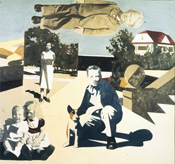
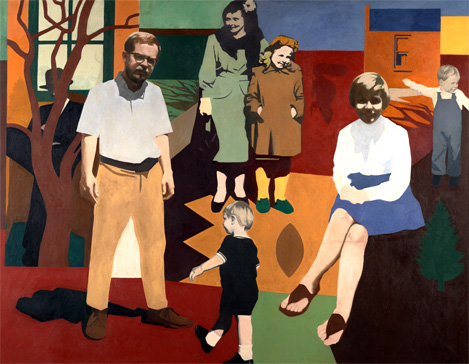
Self-Portrait with Family, 1969, oil on linen, 62x80" |
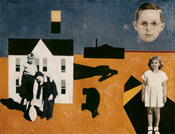
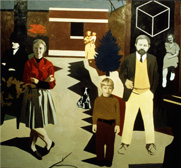
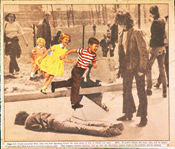
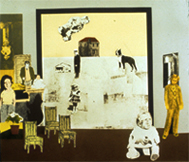
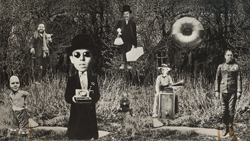
Roger Winter tends, in effect, to detach himself from the scene and to muse – even brood – on other subjects as if in terms of ontology. He is devoted to the significance of individuals as relationships invoke it. His peculiar convocations are the means of revelation. Photographic representations of people lose their facsimile formulas in the combinations he devises and take on a deeper reality, as in a vivid dream.
True-to-life images take positions with exact spatial reference to each other and to the picture’s perimeter. Away back there, somehow, you may feel a ghostly trace of Poussin’s fine French hand. Winter’s schematic patterns are more overt and discontinuous, a device that suits his special way of dramatizing individual subjects by seeming isolation where each still vibes with the others.
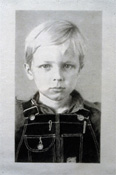
In posture and detail, each subject is an outcome of character sympathy. The stance, how the fit of a coat collar slips from the sartorial into the manner of the wearer, a pocket-jammed hand, the touch of a neighbor’s arm – such sights are sensitively there though underplayed. They are the taken-for-granted modes of intimate rhetoric, exposures of unconscious habit when a person is more or less getting along with others. Almost always it is the relationship that brings you back to the individual.
To convey this relationship in terms of his own graphic rhetoric, Winter thinks of his pictorial setting as being neutral – as being devoid of the spatial reference that connects objects within a continuum which provides everyday linkage. It is without earth’s gravity and there is no chance of physical collision. Sentiment is disembodied. Images can be floated in, rightside up, in groups, single, sideways; they may appear as if solid, or fading like a tintype.
Our reaction to a picture at large is played against response to detail in its content. These solemn inside figures send out separate messages. Yet from outside we see them as interdependent and regard the whole as a taut potential. But inside the static, formal world Winter has created for his subjects, they can get no closer to each other than they are. In being warm and gentle aboiut all this, Roger makes the inexorable solitary mood the more acute.
Douglas McAgy, 1971